
Tree Trimming in Hoover, AL: Dead Wood, Roof Limbs and Lines
The short answer
Trimming at a Hoover, Alabama home usually means taking dead wood out of big oaks, lifting limbs off a roof or driveway, and clearing branches from the service line to the house, and HomeGuide puts the typical job at $400 to $900 per tree (checked Nov 17, 2026). What it should not mean is topping: the City of Hoover's own FAQ calls topping a destructive practice with no known benefits.
Below: what good trimming looks like, which limbs to worry about, what Alabama Power handles near its lines, timing, and prices by tree size.
Why does Hoover warn against topping trees?
Topping is cutting the top of a tree off flat, or cutting big limbs back to stubs. The City of Hoover's FAQ calls topping harmful. Another answer on the same page, about crape myrtles, says "Topping is a destructive practice with any species of tree" (City of Hoover FAQs, checked Nov 16, 2026).
The reason is how trees respond. A topped tree pushes out a crowd of fast, weakly attached shoots from each cut, and the stubs below often rot. A few years later the tree is taller again, denser, and more likely to drop limbs. If someone offers to "top" a large oak or pine to make it safer, that runs opposite to what the city tells residents.
Good trimming removes a limb back to the trunk or to a side branch big enough to take over, leaving the collar at the base of the limb intact so the wound can close.
Which limbs on a Hoover tree actually need to go?
Dead wood over the house
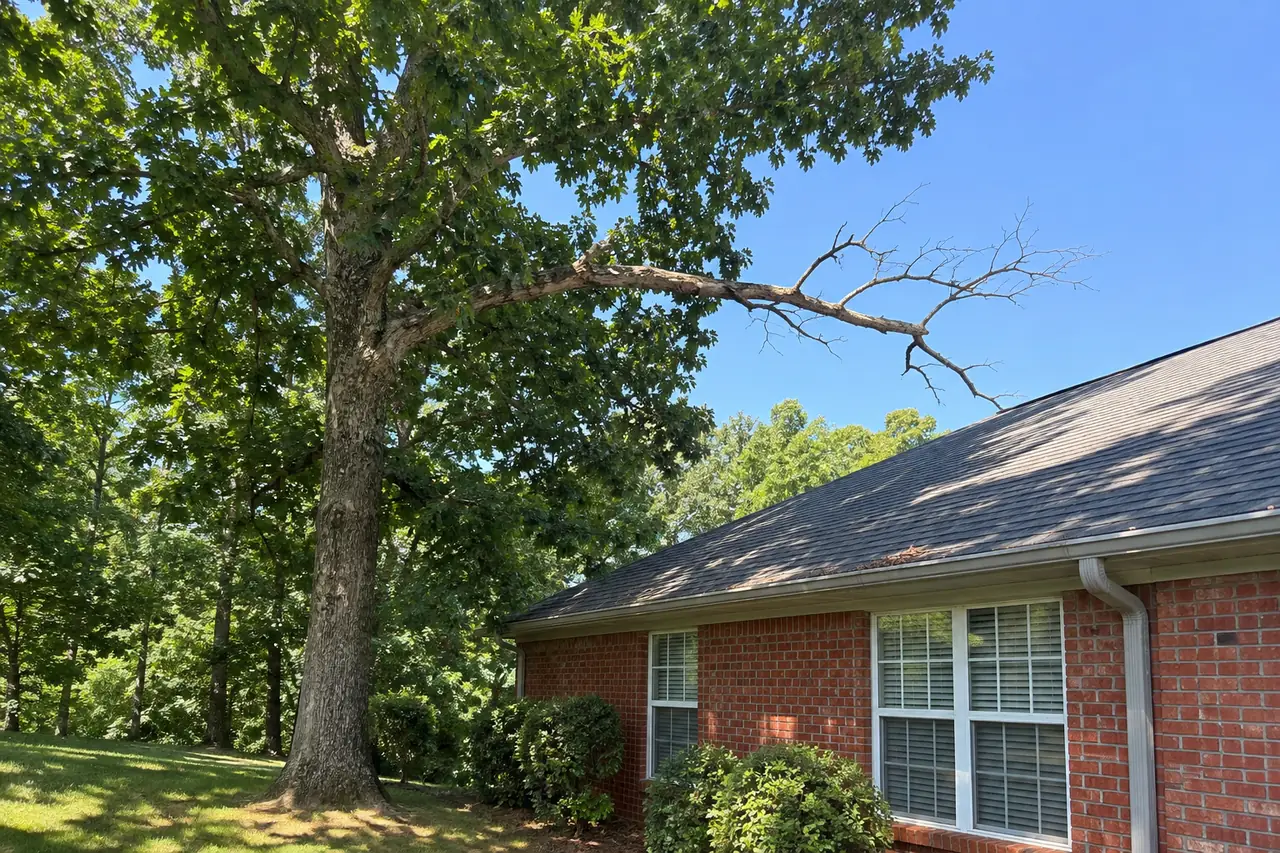
Dead limbs in a big oak are the most common reason to call. They are brittle, they come down in wind, and on a sloped lot the tree is often leaning over the roof. A limb that has lost its bark, has no leaves in summer, or has fungus growing on it is dead.
Limbs on the roof
Branches that rest on or rub the shingles wear through them and drop leaves in gutters. Clearing a few feet of space over the roof is ordinary trimming.
Low limbs over driveways
Hoover driveways climb, and delivery trucks and the garbage truck need height. Raising the lowest limbs is called crown raising or lifting.
Crossing and cracked limbs
Two limbs rubbing each other wear through the bark. A limb with a crack at its base after a storm can hang on for months and then let go.
Weight at the ends
Long, heavy horizontal limbs on water oaks and willow oaks can be reduced by cutting back to a smaller side branch, which takes weight off the end without stubbing.
What about limbs near power lines?
Alabama Power trims trees along its lines to keep service reliable and says it generally maintains a 30-foot-wide easement for overhead lines, 15 feet each side of the line. In maintained or landscaped settings, its policy is to dispose of small limbs and brush it cuts. Requests go through an online form, and the company says a representative responds within 5 to 7 business days (Alabama Power, Residential Vegetation Management, checked Nov 17, 2026).
The same page says only line-clearance qualified personnel should do tree work around power lines, and that an unqualified person should not work within 10 feet of overhead lines under 50,000 volts. That rules out a homeowner on a ladder with a pole saw, and it means you should tell any tree contractor about wires before they arrive.
The page does not say who trims around the service drop, the single line from the pole to your house. Ask Alabama Power about that line before hiring anyone to work near it. If a limb is lying on any line, or a tree has fallen into one, Alabama Power says to contact it immediately and treat the line as live (Alabama Power, Trees and Rights of Way, checked Nov 17, 2026).
Do you need permission from Hoover to trim?
Not for an occupied house. Hoover's ordinance defines land disturbance as changing the land surface or removing trees and woody vegetation; it doesn't mention trimming, and disturbance on an occupied single-family residential lot done by the owner, occupant or their agent is exempt either way (Sec. 13.02.02, City of Hoover Zoning Ordinance, checked Nov 16, 2026). Trees along the street that may belong to the city are another question; the city lists Public Works at (205) 739-7150 for questions about trees (City of Hoover, Urban Forestry, checked Nov 16, 2026).
When is the best time to trim in Hoover?
Dead wood and broken limbs can come out any time of year; there's no reason to wait on a hazard. For routine trimming of live wood, many crews like late fall and winter, when the leaves are off and the structure of an oak is easy to see. Spring and summer work is common too.
For pines, timing matters more. Auburn's extension specialists list trunk wounds among the stresses that bring on bark beetles, and note that wounds release resin that draws beetles in (Alabama Cooperative Extension, FOR-2049, checked Nov 17, 2026). Avoid unnecessary wounds to pines.
What does trimming cost?
| Height of the tree | HomeGuide's typical price for one tree |
|---|---|
| Below 30 ft tall | $250 – $700 |
| Between 30 and 60 ft | $600 – $1,200 |
| Taller than 60 ft | $1,000 – $2,500+ |
HomeGuide also lists oaks at $450 to $1,500 to trim and pines at $250 to $1,600, and says most companies have minimum job charges of $100 to $300 or more (HomeGuide, Tree Trimming Cost, checked Nov 17, 2026). For a single broken branch, its limb-removal guide gives $75 to $250 for a small or medium branch (HomeGuide, checked Nov 17, 2026).
A mature oak or pine over 60 feet tall falls in the tallest row. A tall oak above a house on a slope, where every cut limb has to be roped down, lands at the high end. See the price page for more.
Questions worth asking about a trimming job
- Which limbs are coming out, and why? Can you point to them from the ground?
- Will any cut leave a stub or take the top off the tree?
- Will the climber use spikes? (On a tree that's staying, they shouldn't.)
- Is the brush chipped and hauled, or left?
- Is anything near the service line, and has Alabama Power been asked about it?