
Tree Removal in Hoover, AL: When It Comes Down and How
The short answer
A tree at a Hoover, Alabama home should come down when it is dead, dying from bark beetles or decay, cracked or split at the trunk, uprooting, or leaning harder toward a house than it used to. If you live in the house, Hoover's zoning ordinance exempts that removal from the city's land disturbance permit (Sec. 13.02.02, read Nov 16, 2026), and the contractor you hire is the one who hauls the wood away.
The rest of this page covers the warning signs, how a tree near a house is taken apart, what makes a removal harder here, and what to settle before the saw starts.
Which trees in a Hoover yard are worth taking down?
Not every big tree near a house is a problem. Oaks, hickories and tulip poplars can stand for generations when they are sound. The ones worth a closer look show at least one of these:
- Dead or dying crown. A pine whose needles have gone from yellow to rusty red, or a hardwood that leafs out only on its lower half. Auburn University extension specialists note that red needles generally stay on a beetle-killed pine, so a red top is easy to spot from the street (Alabama Cooperative Extension, FOR-2049, checked Nov 17, 2026).
- Bark beetle signs on a pine. Small popcorn-like blobs of dried resin on the trunk, or boring dust in the bark crevices and at the base. For Ips engravers and southern pine beetle, the same extension publication says to remove the tree immediately and grind the stump.
- Decay in the trunk. Hollows, soft or punky wood, cankers, and fungus fruiting bodies on the stem. The Alabama Forestry Commission lists these as visible signs of hardwood decay and says canker-rots "particularly attack southern red oaks" (Alabama Forestry Commission, Hardwood Decay, checked Nov 17, 2026).
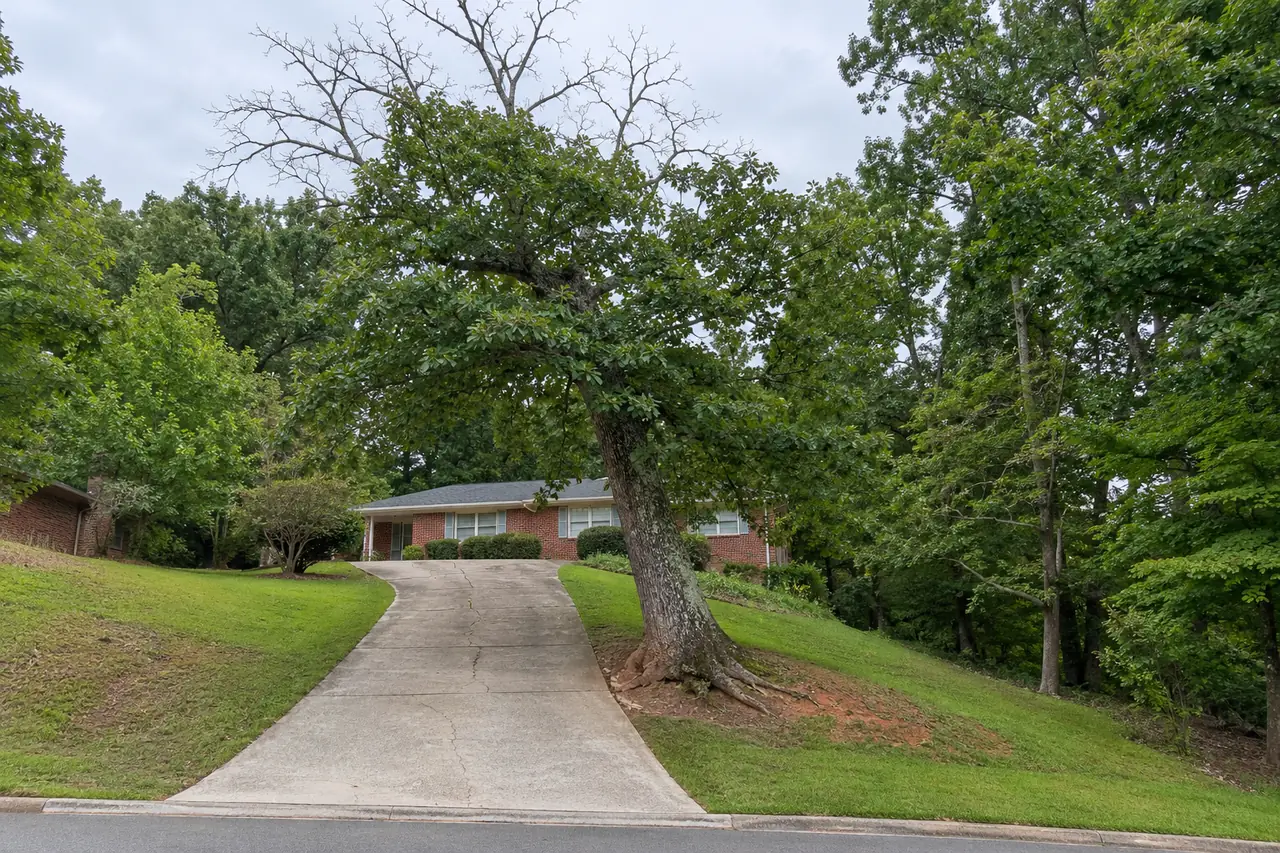
- A new or growing lean. Some trees have leaned all their lives. A lean that appeared after a storm, with cracked or heaved soil on the far side of the trunk, is different: the roots are letting go.
- Split trunks and big cracks. Two leaders joined in a tight V with a crack running down between them, or a vertical crack in the trunk after high wind.
- Construction damage. Roots cut for a driveway, a sewer line or an addition. Root damage from construction is one of the stresses the extension service links to bark beetle attack in pines.
If you aren't sure, say so in your request. The contractor will look at the tree; whether it needs to come down is a fair question to ask them.
How is a big tree taken down next to a house?
In a wooded Hoover neighborhood there is rarely room to drop a 70-foot oak in one piece. The usual method near a house is to take it apart from the top down:
- Limbs first. A climber or a bucket truck works up the tree, cutting limbs into pieces small enough to control. Over a roof or deck, each piece is tied off and lowered on a rope run through a block higher in the tree.
- Then the trunk, in sections. With the limbs gone, the trunk is cut down in lengths. Where there is open lawn, sections can be dropped. Where there isn't, they are lowered too.
- The last section felled. Once the trunk is short enough to fall in the space available, it is notched and felled.
- Wood and brush out. Brush goes through a chipper that blows the chips straight into the chip truck at the street. Trunk wood is cut into rounds and loaded or carried out.
When there is no safe way to lower wood, a crane lifts each piece over the house. On Hoover's slopes that happens more than in flat towns; the steep-lot page covers it.
What makes a removal in Hoover harder than it looks
The slope
The city history describes Hoover as spreading down the slope of Shades Mountain (City of Hoover, checked Nov 16, 2026). A tree uphill of a house has everything working against the crew: pieces want to roll toward the house, and equipment can't park on the grade. A tree downhill in a ravine has the opposite problem, because every round of trunk wood has to come back up.
Wires
Service lines run from the pole to the house through a lot of Hoover backyards. Alabama Power's guidance is that an unqualified person should stay at least 10 feet from overhead lines below 50,000 volts (Alabama Power, checked Nov 17, 2026). Mention any line near the tree when you call.
Rock and clay underfoot
Red clay gets slick after rain, which matters when a crew is walking heavy wood across a sloped yard. Machines that can leave ruts in a dry lawn can leave deep ones in a wet one. Ask how equipment will get in and whether mats or plywood will go down.
The neighbor's side
When a tree stands on or near a property line, the crew may need to step onto the next lot or drop pieces there. Talk to your neighbor before the work date, not on it.
Does Hoover require a permit to remove a tree?
For an occupied house, generally no. Hoover's ordinance includes "the removal of trees and other woody vegetation" in its definition of land disturbance and requires a land disturbance permit for regulated disturbance, but it exempts land disturbance on an occupied single-family residential lot done by the owner or occupant or their agent, and it exempts emergency work to protect life, limb or property (Secs. 13.02.01 and 13.02.02, City of Hoover Zoning Ordinance, checked Nov 16, 2026).
Cases that fall outside that exemption, including vacant lots, houses under construction with a tree conservation plan, and planned unit developments with their own rules, are on the Hoover tree rules page. A homeowners' association may also have covenants about trees; those are private rules the city doesn't enforce, so check your own papers.
Where does all the wood go?
With the contractor. Hoover's trash page says debris from landscaping work "is to be removed by the contractor performing the service," and only homeowner-generated material should be scheduled for city pickup (City of Hoover, Trash & Recycling, checked Nov 16, 2026). A removal price that leaves the trunk wood for you, or leaves brush at the curb, is a different price from one that clears everything. Ask which you're getting.
Some homeowners keep the trunk wood for firewood. If you do, say so before work starts so the crew cuts it to a length you can handle.
What about the stump?
Stump grinding is often a separate line on the price. HomeGuide puts a first stump at $120 to $400, with additional stumps at $30 to $60 each (HomeGuide, checked Nov 17, 2026). If the tree was a pine killed by Ips or southern pine beetles, the extension advice is to grind the stump too. The stump grinding page covers 811, depth, and the chips.
What does a removal cost in Hoover?
Angi's Birmingham figures put the average for tree or shrub removal and trimming at $1,096, with most jobs between $572 and $1,732 (checked Nov 17, 2026). HomeGuide's national table runs from $150 to $500 for trees under 30 feet up to $1,200 to $2,700 for trees over 80 feet, and adds $500 to $2,500 a day when a crane is needed (HomeGuide, checked Nov 17, 2026). On a Hoover hillside, the crane and the carry-out are what push a price toward the top of those ranges. More on the price page.
Things to settle before the crew starts
- Exactly which trees are coming down. Tie a ribbon on each one if there's any doubt.
- Whether the price includes hauling everything, or leaves wood or brush behind.
- Whether the stump is ground, and how deep.
- How equipment will reach the tree and what happens if the lawn, a drive or a wall is damaged.
- What gets moved beforehand: cars, grills, planters, patio furniture.
- Whether the neighbors know.
The hiring guide has more on contracts and deposits, including the Alabama attorney general's advice on payment.