
Steep-Lot Tree Removal in Hoover, AL: Slopes, Ravines and Cranes
The short answer
Taking a tree off a steep lot in Hoover, Alabama is done by roping each piece down or lifting it out with a crane, because on a hillside the cut wood can't simply be dropped and rolled away. That extra rigging and carrying is why a hillside removal costs more: HomeGuide adds $500 to $2,500 per day when a crane is needed (checked Nov 17, 2026).
This page explains why Hoover has so many of these jobs, the ways crews handle them, what you can do to make one go smoothly, and what to expect on price.
Why are so many Hoover lots steep?
The city grew on a mountainside. Hoover's own history says the city "sprawls down the slope of Shades Mountain," with the Cahaba River crossing its southern section, and that by 1989 its limits took in Bluff Park (City of Hoover, A History of Hoover, checked Nov 16, 2026). Houses were built on ridgelines, on benches cut into the slope, and along the edges of ravines, with wooded ground left above and below them.
That gives three common setups:
- Tree uphill of the house. The base of the tree may be level with the gutters. Anything cut loose wants to go downhill, toward the house.
- Tree downhill in a ravine. Nothing threatens the house when pieces fall, but every round of trunk wood has to come back up the slope, often by hand.
- Tree on a bench between two houses. The ground is narrow and level for a few feet, then drops. There's nowhere to land wood and little room to stand.
How do crews take a tree off a slope?
Roping pieces down
The most common method. A climber works up the tree, sets a lowering line through a pulley or block high in the tree, and ties off each limb or trunk section before cutting it. A ground worker controls the line, letting the piece down slowly to a spot where it can land without hitting anything. On a slope, the landing spot is usually uphill or beside the tree, not below it.
Lifting with a crane
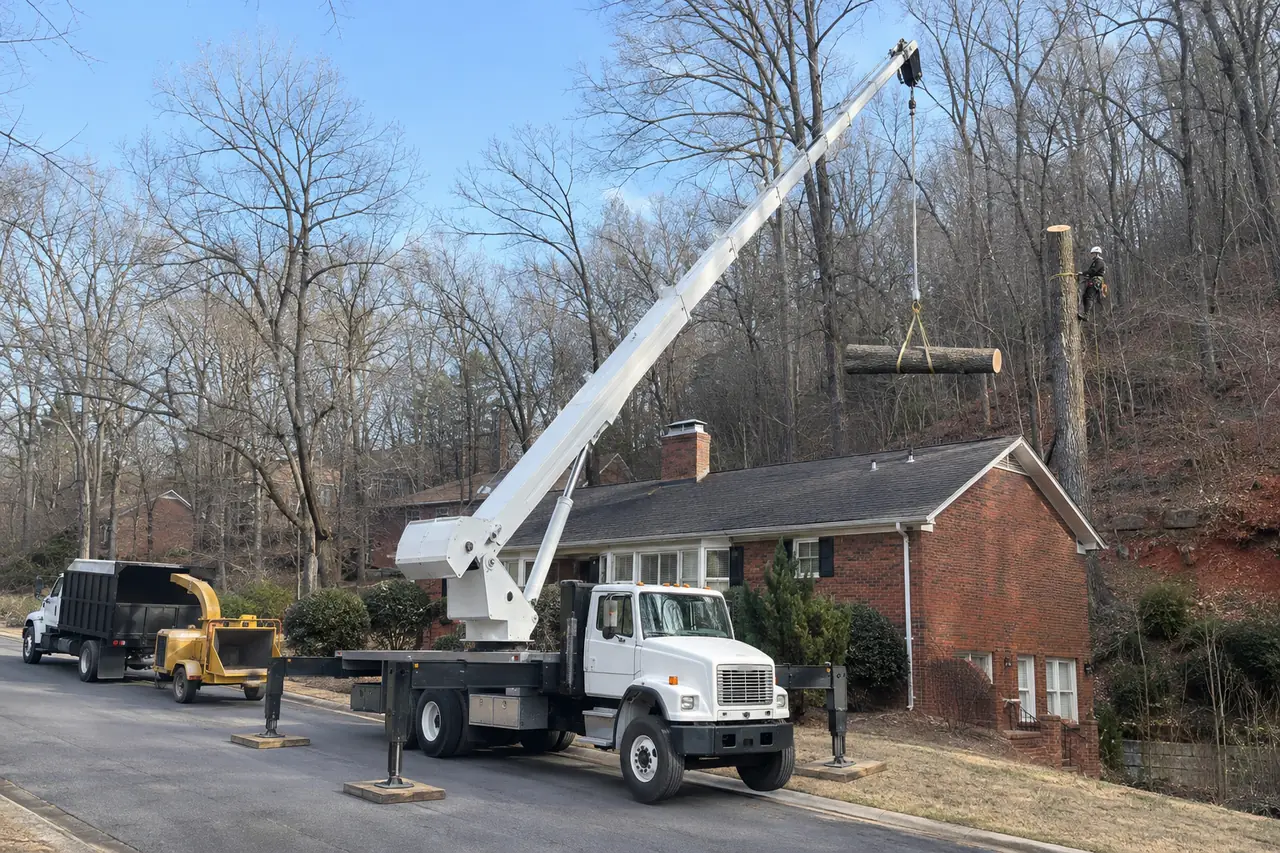
When there is no safe landing spot, or the tree is too big or too rotten to climb, a crane lifts each piece out. The climber (or a worker in a bucket) attaches the crane's line to a section before it is cut, the crane takes the weight, and the section is swung over the house to the street or driveway, where it is cut up and loaded. A crane needs firm, level ground for its outriggers, which in Hoover usually means the street or a flat driveway, and its reach determines how far back on the lot it can work.
Bucket trucks
A bucket truck is quick when it can park near the tree on level ground. On steep lots it often can't, so it ends up working from the street on front-yard trees only.
Carrying out
Once the wood is on the ground, it has to leave. Brush is dragged to the chipper at the street, which blows chips straight into the chip truck. Trunk wood is cut into rounds small enough to carry or roll onto a small loader. In a deep ravine, some crews leave large trunk sections on the ground to rot if the owner agrees; that's cheaper but not always wanted.
What does Hoover's ground add?
Red clay is slick when wet, which matters for anyone carrying wood down a grade or for any machine trying to climb one. A day of rain can push a hillside job back. Rock ledges and outcrops on the slope limit where a crew can stand and where rounds can land.
When a tree on a slope is taken out, its roots are left in the ground and slowly rot. A contractor may not grind a stump on a steep bank where the machine can't stand safely; the stump can stay. If erosion on a bare slope worries you after several trees come out, that's worth raising before the work.
A note on scale: Hoover's zoning ordinance counts the removal of trees as land disturbance and requires a land disturbance permit for regulated disturbance, but exempts an occupied single-family lot when the owner, occupant or their agent does the work (Secs. 13.02.01–13.02.02, City of Hoover Zoning Ordinance, checked Nov 16, 2026). Grading or clearing on a vacant hillside lot is a different matter; see the rules page.
Access through a neighbor's yard
On many hillside lots, the only path to a back-slope tree, or the only level place to land wood, is next door. Ask your neighbor ahead of time, explain what the crew needs, and agree on what happens if a fence section has to come down or a bed gets trampled. A crane parked in the street may also block a neighbor's driveway for part of a day.
Storm trees on a hillside
A tree that has fallen on a slope is often under load in odd directions: the root plate may be holding it up, the top may be resting on a roof, and the trunk may be twisted. When the root plate lifts, it can leave a wide crater of red clay on the hillside. Cutting a tree like that releases its tension suddenly. The National Weather Service's survey of the April 27, 2011 Cahaba Heights tornado notes that "a person was killed during clean-up efforts" (NWS Birmingham, checked Nov 17, 2026). Leave fallen trees on a slope to a crew. See the storm page.
What does a steep-lot removal cost?
There is no separate published "hillside" price. Use the general ranges and expect the slope to push you toward the top of them:
| Item | Range | Source |
|---|---|---|
| Large tree, 60 – 80 ft | $650 – $2,000 | HomeGuide |
| Extra-large tree, over 80 ft | $1,200 – $2,700 | HomeGuide |
| Crane added to a removal | $500 – $2,500 per day extra | HomeGuide |
| Hauling debris | $75 – $250 per dump trip | HomeGuide |
| Tree or shrub removal and trimming, Birmingham, AL | $1,096 average (low to high $200 – $2,850) | Angi |
When several trees on the same slope come down on the same crane day, the crane cost is shared across all of them. Ask whether grouping nearby trees makes sense.
How to help a hillside job go well
- Point out exactly where the property line runs, especially at the bottom of a ravine.
- Move cars off the street or driveway where a crane or chip truck may set up.
- Talk to neighbors about access and about the street being partly blocked.
- Mention septic fields, retaining walls and drainage pipes on the slope; heavy loads and machines should stay off them.
- Ask what happens to wood in the ravine: hauled out, or left to rot.
- Agree on weather: what happens if rain makes the slope unsafe on the scheduled day.
To have one independent contractor look at a tree on your slope, call (205) 402-8078 or send a request and mention the slope in your notes.