
Dying Oaks and Pines in Hoover, AL: Beetles, Drought and Decay
The short answer
Pines in Hoover, Alabama yards usually die from bark beetles that move in after stress, and Auburn University's extension specialists say Ips engravers and southern pine beetle can kill a pine within one to two weeks, so their advice for an infested tree is to remove it and grind the stump right away (checked Nov 17, 2026). Oaks decline more slowly, from drought damage that can take one to two years to show, from hypoxylon canker that follows dry years, and from trunk decay.
This page sets out the signs for each, using Alabama Cooperative Extension and Alabama Forestry Commission material, and when a declining tree near a house should come down.
Which beetles kill pines in Alabama yards?
Alabama Cooperative Extension's publication on urban pine bark beetles lists the black turpentine beetle, three Ips engraver species and the southern pine beetle as common in Alabama (ACES FOR-2049, Managing Pine Bark Beetles in Urban Forests, checked Nov 17, 2026). A newer extension page from April 2026 adds that Ips beetles "can produce multiple generations in a single year," and that southern pine beetle outbreaks "can rapidly kill large areas of pine forest" (ACES, Bark Beetles Threatening Alabama's Forests, checked Nov 17, 2026).
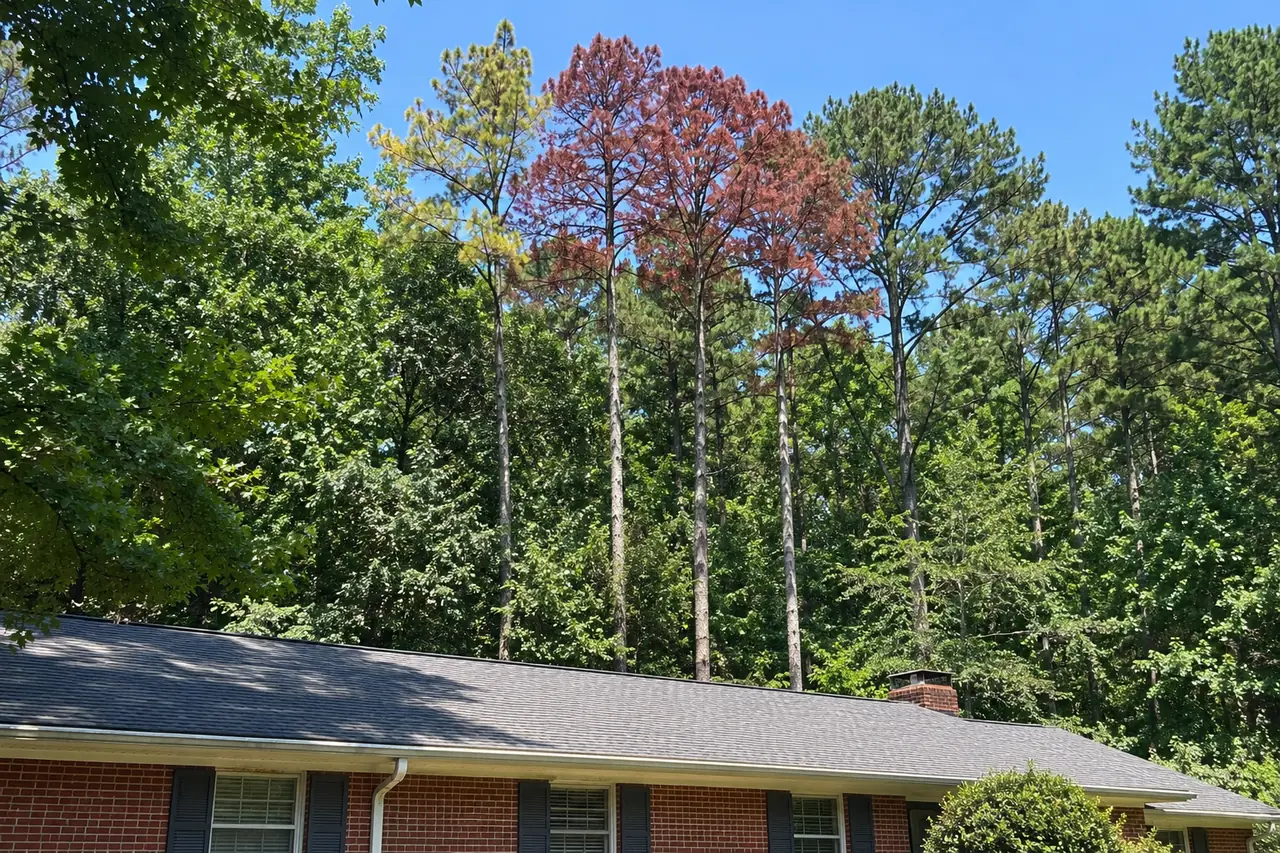
That speed is why a single red pine in a group deserves attention: where pines stand together on a wooded lot or along a ravine, the trees next to an infested one are the ones at risk.
How can you tell a pine has beetles?
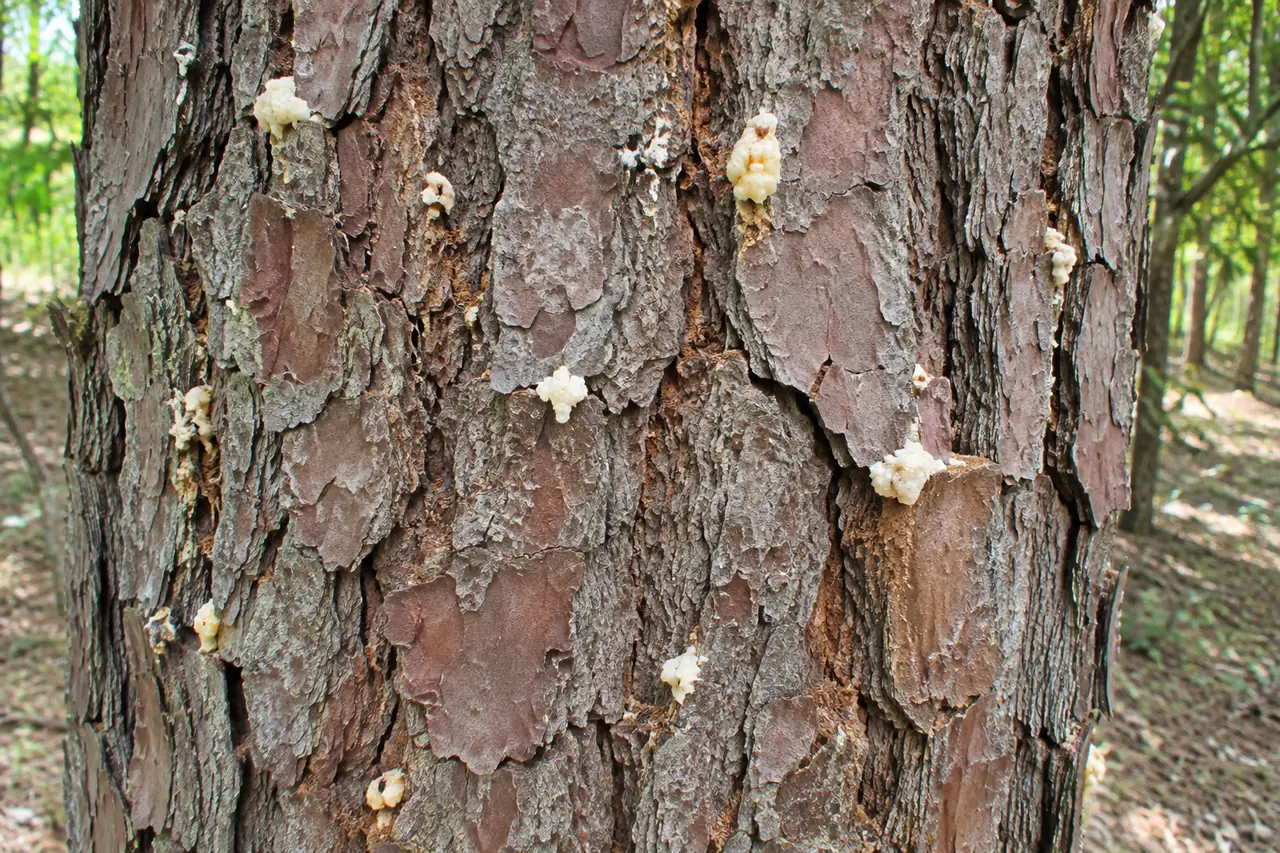
- Pitch tubes. The extension service describes them as "popcorn-like spots of dried pine resin" on the trunk. Ips tubes are small, about the size of a dime, and run from pinkish white to yellowish depending on age. Black turpentine beetle tubes are large, more than an inch across, and usually sit within the lowest 8 feet of the trunk.
- Boring dust. Reddish brown boring dust in the bark crevices or on the ground at the base. During drought, the extension service notes, pitch tubes may be absent and this dust may be the only sign.
- Needle color. Needles turn yellow, then rusty red, and "red needles generally will persist on the tree."
- Galleries under the bark. Ips beetles leave "distinct H-, Y-, or I-shaped galleries" visible when loose bark is pulled away.
- Several trees at once. The Alabama Forestry Commission's FAQ says fading and red needles indicate diminishing tree health, and that a group of trees in that condition generally points to pine beetle activity (Alabama Forestry Commission FAQ, checked Nov 17, 2026).
Why do pines in a yard get attacked?
Stress. The extension publication lists root damage from construction, trunk wounds, lightning strikes, overcrowding, drought and storm damage as the triggers, and notes that wounds release resin that attracts beetles (ACES FOR-2049, checked Nov 17, 2026). In a Hoover subdivision, that list reads like a description of normal life near a pine: a new driveway, a sewer line trenched past the roots, a dry summer, a storm that bent the crown.
For Ips specifically, the April 2026 extension page advises salvaging storm-damaged wood promptly and removing slash, since downed pine is breeding material.
What should you do about a beetle-hit pine?
For Ips engraver or southern pine beetle, the extension advice is plain: "Remove the tree immediately and grind the stump." The same publication says these beetles can kill trees within one to two weeks, so a freshly infested tree needs action now, not after the next storm (ACES FOR-2049, checked Nov 17, 2026). The April 2026 page says to "remove infested trees quickly" by cutting, chipping or debarking (ACES, checked Nov 17, 2026).
A dead pine near a house is a hazard of its own.
Can healthy pines nearby be protected?
The extension publication describes preventive options for high-value trees: contact sprays of bifenthrin, permethrin or carbaryl applied to the trunk, which protect for about one to three months; trunk injections of emamectin benzoate, which can control beetles for up to two years but aren't recommended during drought; and verbenone pouches, for southern pine beetle only, with mixed results. It says high-risk trees should be sprayed in late winter or early spring, before the beetles are active, and that a professional applicator is highly recommended, since protecting against Ips and southern pine beetle means treating most of the trunk.
How does drought hurt oaks and other hardwoods?
Alabama Cooperative Extension's guide to drought and landscape trees lists the signs of drought stress: leaves wilting during the day, then staying wilted into the early morning; leaves yellowing early; brown, scorched leaf edges; leaves dropping from the top and branch ends first; and, in a long drought, lengthwise cracks in the bark. Its warning is about timing: the full damage "can take one to two years to become apparent" (ACES, Drought and Landscape Trees, checked Nov 17, 2026).
The same guide notes that trees in shallow or rocky soil are more vulnerable, which describes plenty of Hoover hillsides, and that drought-stressed hardwoods attract ambrosia beetles, black twig borers, and flathead and roundhead borers.
What is hypoxylon canker?
The extension drought guide names hypoxylon canker as a disease that is common in the years after a drought. Put simply, a dry summer can set up a disease problem that only becomes obvious a season or two later, which is one more reason to look hard at oaks that thin out after a drought. If something unusual appears on the bark of a struggling oak, have it looked at rather than guessing.
Watering through a dry spell
The same extension guide suggests a simple test first: dig a hole 6 to 9 inches deep, and if the soil there is cool and moist, watering can wait. When it is needed, the guide suggests starting with one inch of water once a week, spread over the whole area under the dripline and a bit beyond, kept off the trunk and leaves, and put down in the early morning (ACES, Drought and Landscape Trees, checked Nov 17, 2026).
What about decay inside an oak?
The Alabama Forestry Commission says hardwood decay is caused by fungi and that wounds from insects, weather, fire, animals and people leave trees predisposed to decay. Visible signs include hollows, rotten wood, cankers, lumpy or irregular stems, scars and "fungus fruiting bodies on stems." It names southern red oak specifically: "Canker-Rots particularly attack southern red oaks" (Alabama Forestry Commission, Hardwood Decay, checked Nov 17, 2026).
The commission is just as plain about treatment: once decay begins, there is no control. What you can manage is the risk. A decayed oak in the woods can be left; a decayed oak over a bedroom is a different decision.
When should a declining tree near the house come down?
- A pine with fresh pitch tubes, boring dust or a red crown: now, per the extension service, along with the stump.
- An oak with cankers, a sloughing patch of bark or fungus fruiting bodies on the trunk: soon, if it can reach a house, drive, play area or line.
- An oak thinning from the top two summers after a drought: watch it, water it, and have it looked at. Some recover. Large dead limbs over the house should come out either way.
- A tree with a large cavity or soft wood at the base: have it looked at before storm season.
The Forestry Commission's FAQ adds that diagnosing a sick tree "can not be answered over the phone"; someone needs to see it. To have one independent contractor look at a declining tree at your Hoover home, call (205) 402-8078 or send a request. For tree health questions on their own, the Jefferson County office of the Alabama Cooperative Extension System is another place to ask.